
With hundreds of tennis tutorial videos on Youtube and other media sites covering different aspects of the game from technique to footwork to strategy, learning the sport has never been more accessible. Now that you have gained all the knowledge there is to a perfect forehand, all that’s left is to participate in an ITF tournament and become a pro, right?
If only it was that easy.
Even if you have studied all of the theory there is to a tennis game, execution of the theory is an entirely different skillset. No one is successful in applying what they’ve learned the first time. Rather, improvement is a process of fixing flaws in your game while developing muscle memory and intuition. Repetitive practice leads to improvement.
However, there are ways to optimize this process to improve faster and ensure no bad habits are introduced to your game.
1. Start with shadow tennis
When you learn a new technique or footwork, practice going through the motion without a ball first. You can do this on the court or off the court. Visualize a ball coming towards you and apply your technique on the ball. Actively think about the motion and the principles behind it until you feel comfortable and more confident in its function.
2. Self analyze your own game
When you actually try doing the theory on court, set up a camera and record yourself. Watch the play back and evaluate whether you are applying what you learned properly. Ask yourself these questions:
Are you doing every principle correctly?
- Is there anything that differs between what you learned and what you are doing?
- Is every principle you are doing serving the function it is supposed to serve?
- Is there anything that doesn’t feel or look right?
- Did you change any good habits that you were doing before but not doing now?
Bring a notebook and write down the changes you want to try changing in your game, and repeat this process.The last question is essential because it is common to unconsciously change something foundational to your game when introducing something new to your game. It is easy to overlook this change since you are so focused on the new theory. To prevent a bad habit from developing, this question must be asked.
3. Have an expert in tennis theory analyze your game
One of the main purposes of a tennis coach, especially for advanced players, is to recognize flaws that the players themselves miss. Another role is the maintenance of a tennis player, which is recognizing when bad habits develop and pointing them out.
Even though self analysis is beneficial and can help reduce your mistakes, you are still prone to miss many errors in your game due to lack of experience in recognizing mistakes and biases towards your game. Having someone who has studied the game far beyond what you have is beneficial, as they have experience in seeing flaws and approaching these flaws in a solvable way.
Note: Even among coaches, there is still a large skill gap between how good a coach is. A high level player(like D1 or pro) does not guarantee they are knowledgeable or have good observational skills.
At Brute Tennis, we offer our services in coaching for a fraction of the price of taking private lessons. The quality of our coaching can be validated from the videos showing the knowledge we can offer.
4. Stop thinking about theory
The last step of all this is to forget the theory. No good player is constantly thinking about their form or is entirely consumed by strategy at all times. When you focus on a specific part of your game, you can expect to temporarily play worse, as you won’t be expending all your mindset to winning the point. At some point, you want to eventually let the technique and footwork be merely muscle memory and strategy be intuitive.
This does not have to be an immediate step. Rather, it is best to alternate your focus. Spend one week where you are focusing on a specific part of your game, then spend the next week not thinking about technique and solely competing to win. Repeat this until you feel you no longer have to focus on that specific part of your game, and move on to another focus.
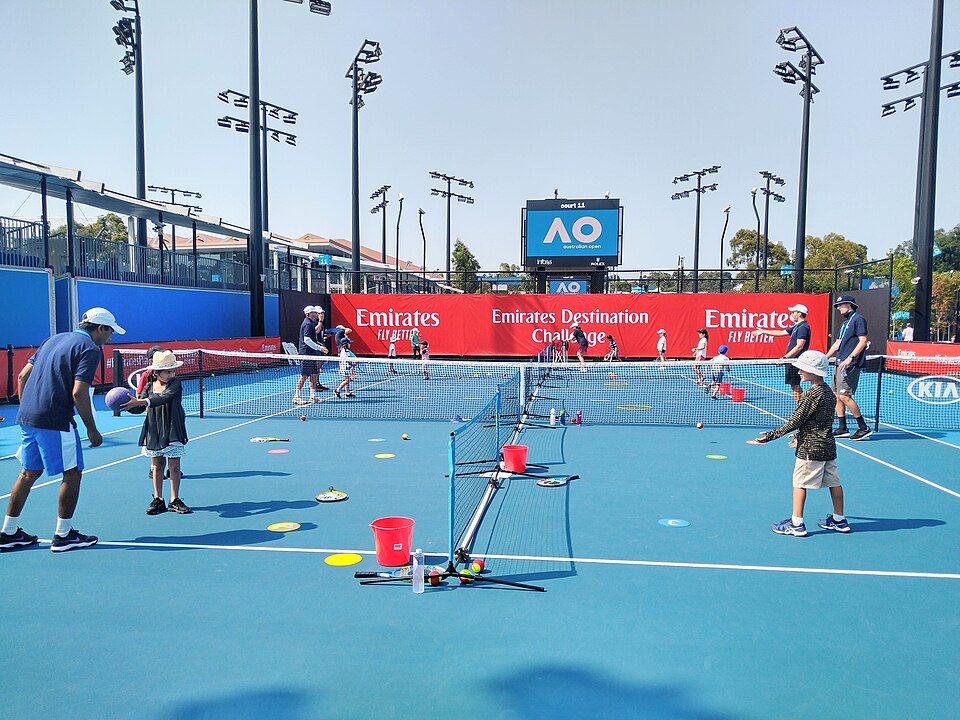
Image by KeepActive Australia under CC 4.0